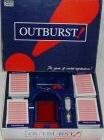
It's called Outburst and is made by Parker games. The version I have was made in the 1980s I think but there are more up to date versions. Amazon sell it here, but it's widely available on Ebay too.
The game in its original format is played like this:
- You have a board with two counters - the aim is for one of you to be the first to get to the end
- One of you chooses a topic - e.g. 'European capital cities'.
- The other person decides whether to pass or play - if they pass, they HAVE to play the next topic.
- On the card are 10 things that the other person has to guess, under the topic - e.g.
- 1. London
- 2. Paris
- 3. Berlin etc , up to 10.
- You then roll two dice, and get a number from 2-10. This corresponds to one of the words above - e.g. if you rolled 3, it would be Berlin. This is the 'bonus' answer.
- You then roll another dice to decide how much that bonus answer will be worth - e.g. 3 points.
- You turn over a timer, and the other person then has a minute to guess as many of the points on the card as possible.
- At the end, you tot up the scores - if they can name 6 of the points, they get 6 points. If they guessed the bonus answer, this gets added to the score - so if they guessed 6, and one of them was answer number 3 'Berlin', this is 6 + 3 so they get to move 9 places.
This is essentially the whole game! It is easily convertible to History - all I did was change the cards over to historical topics e.g. 'Military terms of the treaty of Versailles - 1. 100,000 soldiers, 2. 6 battleships etc, or 'Causes of the First World War - 1. Alliances, 2. Assassination of Franz Ferdinand' etc.
I have made revision resources for both the current GCSE (Causes and events of the First World War + the interwar period), and for the new A-level Edexcel Route H 'Britain transformed' course.
My resources are here:
Outburst cards for OCR MWH Paper 1 Causes and events of the First World War + The Interwar period 1919-1939
If you don't want to buy the actual game, there's some attractive board game templates here - all you need is a format with a start and end, it's up to you how many squares to put on it (there's 50 on the actual game board). I'd suggest blowing it up to A3 and laminating them. There's also some templates for dice on that site.
Advantages:
- Resources are quick and easy to make - just lists of 10 things under different topics, which I ten printed out and laminated
- You could easily make your own version of this game and bypass the boardgame - you'd just need to make your own board with say, 50 squares on it, get some dice and a timer, and then make the cards yourself.
- Kids could make cards themselves for revision.
- It aids the recall of keywords, and helps students to quickly think of key factors under time pressure - all good preperation for exam
- Kids seem to find it fun!
- It can be played in teams - e.g. 3/4 on each side?
Disadvantages:
- I can't really see any major ones, other than sometimes it is difficult to think of words/phrases that are relevant but guessable - this is more difficult for A-level than GCSE.
I've played this twice with my GCSE and A-level students and it has been a hit so far! Although I did allow my A-level students to intersperse the historical cards with the cards in the game, so had an odd combination of 'Liberal laws of the 60s and 70s' followed by 'Eastenders characters' ... :)

