Saturday, 23 April 2016

Game #2 - Outburst revision

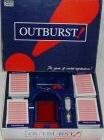
I found this game in a charity shop for £1.50. Never heard of it or played it before but it's been one of the best revision games yet!

Outburst!


It's called Outburst and is made by Parker games.  The version I have was made in the 1980s I think but there are more up to date versions. Amazon sell it here, but it's widely available on Ebay too.

The game in its original format is played like this:


  • You have a board with two counters - the aim is for one of you to be the first to get to the end
  • One of you chooses a topic - e.g. 'European capital cities'.
  • The other person decides whether to pass or play - if they pass, they HAVE to play the next topic.
  • On the card are 10 things that the other person has to guess, under the topic - e.g.
  • 1. London
  • 2. Paris
  • 3. Berlin etc , up to 10.
  • You then roll two dice, and get a number from 2-10. This corresponds to one of the words above - e.g. if you rolled 3, it would be Berlin. This is the 'bonus' answer.
  • You then roll another dice to decide how much that bonus answer will be worth - e.g. 3 points.
  • You turn over a timer, and the other person then has a minute to guess as many of the points on the card as possible.
  • At the end, you tot up the scores - if they can name 6 of the points, they get 6 points. If they guessed the bonus answer, this gets added to the score - so if they guessed 6, and one of them was answer number 3 'Berlin', this is 6 + 3 so they get to move 9 places.

This is essentially the whole game! It is easily convertible to History - all I did was change the cards over to historical topics e.g. 'Military terms of the treaty of Versailles - 1. 100,000 soldiers, 2. 6 battleships etc, or 'Causes of the First World War - 1. Alliances, 2. Assassination of Franz Ferdinand' etc.

I have made revision resources for both the current GCSE (Causes and events of the First World War + the interwar period), and for the new A-level Edexcel Route H 'Britain transformed' course.

My resources are here:

Outburst cards for OCR MWH Paper 1 Causes and events of the First World War + The Interwar period 1919-1939

If you don't want to buy the actual game, there's some attractive board game templates here - all you need is a format with a start and end, it's up to  you how many squares to put on it (there's 50 on the actual game board). I'd suggest blowing it up to A3 and laminating them. There's also some templates for dice on that site.


Advantages:
  • Resources are quick and easy to make - just lists of 10 things under different topics, which I ten printed out and laminated
  • You could easily make your own version of this game and bypass the boardgame - you'd just need to make your own board with say, 50 squares on it, get some dice and a timer, and then make the cards yourself.
  • Kids could make cards themselves for revision.
  • It aids the recall of keywords, and helps students to quickly think of key factors under time pressure - all good preperation for exam
  • Kids seem to find it fun!
  • It can be played in teams - e.g. 3/4 on each side?
Disadvantages:
  • I can't really see any major ones, other than sometimes it is difficult to think of words/phrases that are relevant but guessable - this is more difficult for A-level than GCSE.

I've played this twice with my GCSE and A-level students and it has been a hit so far! Although I did allow my A-level students to intersperse the historical cards with the cards in the game, so had an odd combination of 'Liberal laws of the 60s and 70s' followed by 'Eastenders characters' ... :)

Converting board games etc for revision

It's that time of year when you seem to spend interminable amounts of time going over stuff you have already taught, but which students have completely forgot, and which you hope they will learn again before the actual exam!  Like me, you might feel that the best way to bridge large gaps in understanding is through 'chalk and talk', however my problem with this approach is that by condensing subjects and doing a 'greatest hits' version of the syllabus you inevitably water it down and simplify it. Also, I do feel that it removes the responsibility of the students to revise for themselves - there's no substitute for hard graft.

Therefore, I'm looking for ways of encouraging students to revise independently, and also to encourage the storing of key facts etc in their long term memory, through repitition, regular recall, and interleaving of different topics - all recommended ways of revising suggested in 'Make it stick', which I've already talked about in previous posts.

I'm also conscious that revision must be really boring for a lot of students, so I'm trying to look at ways to make revision more interesting. One way i've been experimenting with has been to convert existing board games etc into revision tools.

So, first up - JENGA revision (other makes are available!)


This idea has already been mentioned in various other places, e.g. Russell Tarr's 'Toolbox', so I don't claim to have invented it!

It's very simple.
1. Buy a Jenga set
2. Label each of the blocks with a number (there are 53 I think)
3. Produce 53 questions, one for each block - e.g. Question 9 - On what date was Franz Ferdinand shot? You could either produce them all on one topic, e.g. Causes of WW1, or have lots of different questions across different subjects.  The disadvantage of the latter approach is that you can only do it once you've finished the entire course, which is a bit of a shame, so probably best to restrict it to reasonably large topics. It does take a while to put the sheets together - you could get the students to do it to encourage them to revise!
4. Get the students to play! It's not really a whole class activity, unless you have several Jenga sets, so it probably works best as a carousel type activity, maybe to break up other stations with exam questions etc.
5. Here's how to play - there are probably different ways, but this is what I'm doing. Students take it in turns to take a block out - they then have to answer the question that is on the block. If they get it right, they keep the block - first to 3 wins? If they get it wrong, it goes back on the top, and play continues until either it falls over or someone gets 3 blocks!

Why this is a good game:
  • It's randomised
  • If students get the answer wrong, it goes back on the top and comes up again, therefore reinforcing knowledge
  • One the blocks are numbered, they can be used for every year group from 7-13 and every topic. Once the resources are made, they can be reused again and again.
  • It can be got out and set up quickly as a educational time filler - much better than sticking on a film at the end of term!
  • It's fun! One student said to me while playing it that 'this is the funnest History lesson i've ever had!'
Downsides:
  • As mentioned above, it does take a while to come up with 53 questions, but you could get the students to do this.
So overall, this one really works!

More soon...

Tuesday, 9 June 2015

On the joys of not using Powerpoint


It has been said by others that Powerpoint has 'neither power, nor point', and in some respects I am inclined to agree.  Therefore this week I have been taking up @teachertoolkit 's challenge to show myself as a resilient teacher by not using Powerpoint for a week.

I'm on day two now and I feel like I'm having withdrawal symptoms.  Other colleagues have remarked on how 'brave' I am, and some students seem dumbstruck when I tell them that I am going PPT 'cold turkey'.

So, what I've been asking myself is, how did we get into this state of affairs? I left secondary school in 1998, and Sixth Form in 2000, and I don't recall having a single PPT shown to me in all that time, yet I don't feel that my education missed out on it.  Students have been taught a variety of subjects for thousands of years without the benefit of Powerpoint, producing intellectuals who it is very difficult for us mere mortals to rival.

Therefore, at what point did it become the educational orthodoxy that every lesson had to have a Powerpoint attached to it as standard?  Presumably at some point between me leaving Sixth form and starting my PGCE training in 2008. Can anyone enlighten me?

Having to cope without a PPT certainly reveals how reliant I had become on it, even just in terms of putting on something from BBC class clips while I gave out hand outs.  Today I taught a lesson on Stalingrad, which I always enjoy teaching,  and usually I go through a few slides to give students the context.  However, as this wasn't an option today we used the relevant section from 'Peace and war' instead to give them the context.  I often don't use 'Peace and war' as I find it pitched a little too high for many students, but it made me consider how I myself have made myself part of the problem by 'dumbing down' the context via PPT, giving them a summary rather than allowing them to read it for themselves.

Having no PPT instead forces one to rely on tried and tested tactics such as reading textbooks, asking questions, and coming up with activities such as role play.

Some of the feedback we had from a recent HMI inspection was that our kids are rather too passive.  It makes me wonder whether we haven't helped to create this situation by boring kids to death with endless Powerpoint presentations!

Friday, 5 June 2015

New Key Stage 3?

So like many of you,  we've been scratching our heads over how to prepare for the new History GCSE (at least for OCR), which is mostly thematic, unlike the way we've taught History since I trained in 2008.

Initially I severely disliked the idea of thematic teaching, thinking that it would lead to gaping black holes in students knowledge, with little 'islands' of knowledge (i.e. The Tudors) surrounded by the modern equivalent of 'Here be dragons'.  However,  I've come to realise that the reality is this happens anyway through chronological teaching, where students seem to forget almost everything they've learned from year to year.

Recently I've been very influenced by the work of Brown, Roediger et al in their work 'Make it stick' , which I was introduced to after attending the training for the Cambridge PGCE mentors.  My understanding of their work is that the only way we can hope to get students to remember anything is by continually revisiting  and interweaving topics so that we can reinforce those pesky neural pathways that lead to long-term learning, which isn't what happens with conventional history teaching, where we teaching something like the 'Black Death', assess it afterwards, and then never return to it again.

Therefore, with this in mind, I read TH 130 and Ian Dawson's article entitled 'Thinking across time: Planning and teaching the story of power and democracy at Key Stage 3', which I found very inspiring, particularly Dawson urging us to ask ourselves about... 'each topic.. ‘if you’re never going to refer back to this later in Key Stage 3, why are you doing it at all?’

Instead, Dawson argues that we should try to create common themes across different years that enable students to tell a coherent 'story' at the end of Key Stage 3, for example in his version the story of power and democracy.

Using his ideas as a starting point, I've mocked up a draft scheme of work for next year.  I've also tried to use elements of Michael Fordham's work (see his excellent blog ), in which he argues that progress over time can't be assessed in individual topics, but instead only by assessing not only that entire year's learning, but also in Year 8 going back over Year 7 stuff etc. I've stolen Dawson's idea of making a video at the end of each unit which they can watch, reflect on, and laugh at how much they've grown in the preceding year.

My colleague Alan Carpenter commented that the scheme of work is now chronological 'vertically, rather than horizontally', which I think is a nice way of putting it.

I've been thinking about how much easier this would make many things - e.g. having done this they would be very well prepared for some of the new GCSE topics such as changing role of the monarchy, but also the implications for classroom displays ('Power', 'War') and parents evenings ('little Billy is doing very well in his understanding of 'Power' but his knowledge of 'Empire and exploration' needs work')


WINTER - Power
Test
SPRING – War & Society
Test
SPRING –
EMPIRE AND EXPLORATION
Test
SUMMER – Social History
End of year test
Yr 7
The Monarchy 1066 to Present
End by making video
Test on ‘Power’
Norman Conquest to Wars of the Roses
End by making video?
Test on War and society
Roman/Greek Empires?
Columbus/Captain Cook, maps, founding of Empire
Test on Empire/exploration
Ancient/Medieval Leisure
 
End with video/project?

Test on all aspects learned that year
Yr 8
Recap of Year 7 – watch video
Campaigns for vote – Peterloo to Suffragettes
 
End with video/project?
Test on ‘Power’ – covering 7-8
Recap of Year 7
 
English Civil Wars to Napoleonic wars/Waterloo?
 
End with video/project?
Test on War and society – 7 and 8
Recap of Year 7
 
‘High’ Empire – e.g. India, ‘Scramble for Africa’, gaining of Empire after WW1, colonial wars, Dr. Livingstone, Shackleton, Scott?
French/Spanish empires?
Test on Empire/exploration – 7 and 8
Recap of Year 7
 
Tudor/Georgian leisure
 
End with video/project?
Test on all aspects learned that year + previous year
Yr 9
Recap of 7 + 8
 
Rights and freedom in 19/20th century – Holocaust? Nazis? Russia?
Test on ‘Power’ – covering 7-9
Recap of 7 + 8

1st and 2nd World Wars? Cold War? Recent wars Iraq etc?
Test on War and society – 7, 8, and 9
Recap of 7 + 8
End of Empire – decolonization, Falklands, Moon landings, space..?
Rise of ‘Chinese’ Empire? Globalisation?
Test on Empire/exploration
7 8 and 9
Recap of 7 + 8
 
Victorians, music halls, 20th century, film, computer games..?
Test on all aspects learned that year + previous years


What do you think? Any comments?


A bit about me

"History is that certainty produced at the point where the imperfections of memory meet the inadequacies of documentation.” Julian Barnes

So I tried to start this blog off with a quote about History that made me sound clever and went for the above, which I think sums up pretty nicely some of the difficulties about teaching History.

A bit about me - I teach History in a normal Secondary school in the Cambridgeshire Fens.  The point of this blog is to help me to reflect on some of the lessons I teach,  and to share ideas with other like-minded History teachers about some of the challenges, but also the joy, of teaching a subject that can be amazing, funny, inspiring, but also pretty daunting (especially if you are trying to plan new A-levels, new GCSEs, and new KS3 all at the same time)...

Please do contact me if you want to network - I'm a big believer that History teachers should share as much as possible as to me it seems madness that we all slave away at the same lessons independently instead of sharing more!